Deciphering OSHA Standards Format
If you’ve ever looked at an OSHA citation, audit finding, or safety training requirement and seen something like 29 CFR 1910.178(l)(2), you’re not alone if your first reaction was confusion.
OSHA standards are precise, hierarchical, and intentionally structured — but that structure isn’t always obvious unless someone explains it. Understanding how OSHA standards are organized is a foundational skill for anyone responsible for workplace safety, training, or compliance.
This “back to basics” guide breaks down:
-
What OSHA citations like 29 CFR 1910.178(l)(2) actually mean
-
How to quickly find the exact standard on OSHA’s website
-
Why this matters for training, inspections, and audits
-
How modern tools — including AI — can help interpret standards more efficiently
What Does “29 CFR 1910.178(l)(2)” Mean?
Let’s break it down piece by piece.
29 CFR
-
29 = Title 29 of the Code of Federal Regulations (Labor)
-
CFR = Code of Federal Regulations
This tells you the rule is a federal labor regulation enforced by OSHA.
1910
-
This identifies the OSHA Part
-
1910 = General Industry
1926 = Construction
1915 = Shipyards
1917 = Marine Terminals
If you see 1910, you’re dealing with a standard that applies to general industry workplaces.
.178
-
This is the specific standard
-
1910.178 = Powered Industrial Trucks (forklifts)
At this level, OSHA defines the overall rule and scope.
(l)
-
This is a subsection
-
In 1910.178, subsection (l) covers Operator Training
(2)
-
This is a paragraph within the subsection
-
1910.178(l)(2) addresses training program content and requirements
In plain English:
29 CFR 1910.178(l)(2) refers to a specific forklift training requirement within OSHA’s General Industry standards.
Why This Structure Matters in the Real World
Understanding OSHA’s format helps you:
Find the exact requirement, not a summary or interpretation
Align training content to the correct citation
Defend compliance decisions during audits or inspections
Avoid overtraining or missing required elements
Many compliance gaps occur not because companies ignore safety, but because they misunderstand which part of a standard applies.
How OSHA Standards Are Organized (Big Picture)
OSHA standards follow a consistent hierarchy:
Title (29 – Labor)
Part (e.g., 1910 – General Industry)
Section (e.g., .178 – Powered Industrial Trucks)
Subsection (letters like (a), (b), (l))
Paragraphs (numbers like (1), (2))
Subparagraphs ((i), (ii), (A), etc.)
The deeper you go, the more specific OSHA becomes.
How to Find a Specific OSHA Standard on OSHA’s Website
Here’s a reliable, repeatable method:
Method 1: Direct CFR Lookup
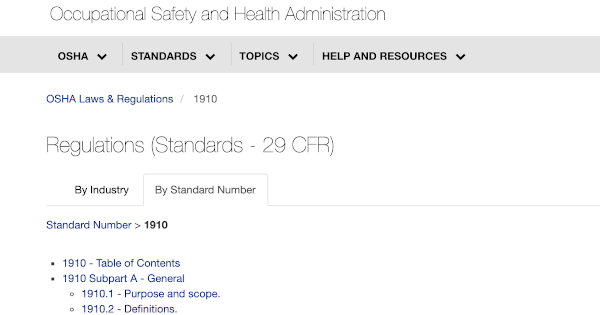
Go to osha.gov/laws-regs/regulations/standardnumber
Enter the standard number (e.g., 1910.178)
Scroll to the relevant subsection (l)
Method 2: OSHA Standards Search
Visit osha.gov/laws-regs/osha-standards
Select the applicable Part (e.g., General Industry – 1910)
Use your browser’s Find feature to jump to the section
📌 Tip: OSHA pages are authoritative but not always user-friendly — bookmarking frequently used standards saves time.
Common Mistakes When Reading OSHA Standards
Even experienced professionals fall into these traps:
Reading only the section title, not the full subsection
Assuming guidance documents replace the regulation text
Missing “shall” vs. “should” language
Ignoring cross-referenced standards
OSHA citations are issued based on the regulatory text, not summaries or training materials.
Where AI Fits In (and Where It Doesn’t)
AI is becoming a powerful assistive tool in safety management — but it should be used thoughtfully.
What AI Can Help With
Explaining regulatory language in plain English
Quickly locating relevant standards
Comparing requirements across industries
Highlighting training triggers and documentation needs
What AI Should Not Replace
The official OSHA regulatory text
Professional judgment
Legal or regulatory interpretation
Used correctly, AI acts like a research assistant, not the authority.
Bringing It All Together
Deciphering OSHA standards isn’t about memorization — it’s about understanding the structure. Once you know how OSHA organizes its rules, citations like 29 CFR 1910.178(l)(2) become navigational tools instead of roadblocks.
And when that understanding is paired with modern tools — including AI-powered search and safety management platforms — compliance becomes clearer, faster, and far more defensible.