Hazard Communication 2026 Deadline
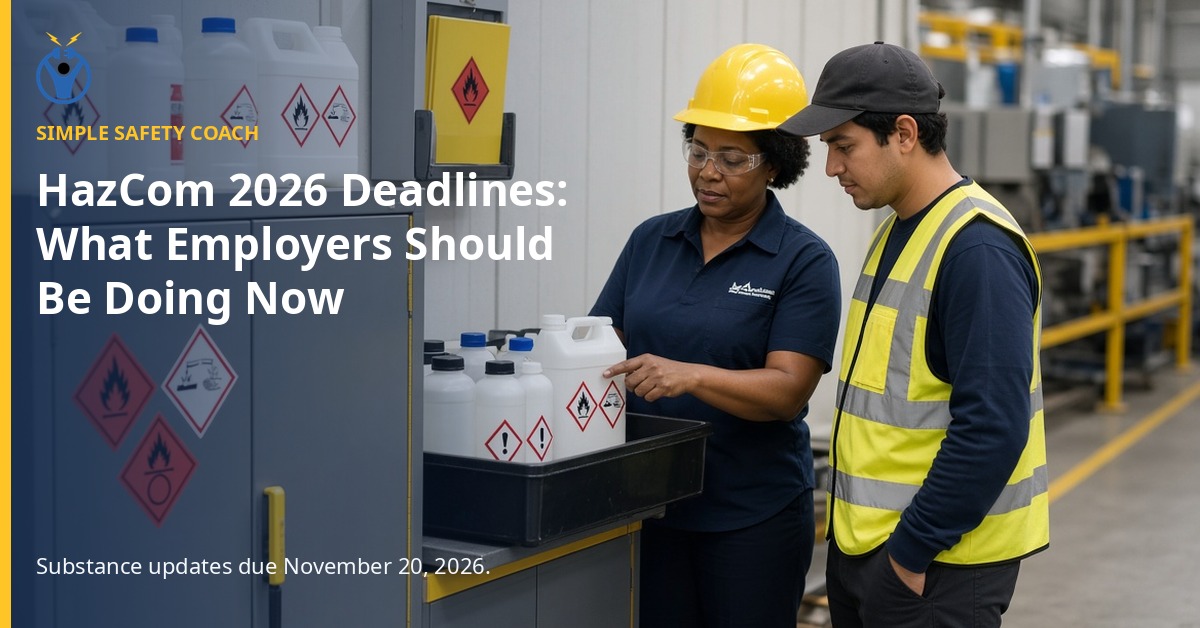
HazCom 2026 Deadlines: What Employers Should Be Doing Now
OSHA extended the compliance dates for its 2024 Hazard Communication Standard update in January 2026. For employers, the extension provides more time—but it also creates a useful window to prepare for revised Safety Data Sheets, labels, written-program updates and employee training as changes move through the chemical supply chain.
The HazCom Update Is a Transition, Not a Single Deadline
OSHA published its final rule updating the Hazard Communication Standard (HCS) on May 20, 2024. The rule became effective July 19, 2024 and primarily aligns OSHA's standard with the seventh revision of the United Nations' Globally Harmonized System of Classification and Labelling of Chemicals (GHS), while also addressing issues OSHA identified after implementation of the 2012 standard.
The revisions affect areas including hazard classification, labels, Safety Data Sheets (SDSs), small-container labeling and other technical requirements. Because those changes begin with chemical manufacturers, importers and distributors and then flow downstream to employers, OSHA established phased compliance dates rather than one universal deadline.
On January 15, 2026, OSHA extended those compliance dates by four months. That extension is important because some older articles, calendars and internal plans may still show the original dates.
During the transition period, OSHA states that chemical manufacturers, importers, distributors and employers may comply with the previous version of the HCS, the updated standard, or both. The practical challenge for employers is therefore not simply remembering a date. It is managing changing information as revised labels and SDSs arrive.
The Current Federal OSHA Compliance Timeline
The extended federal OSHA schedule separates substances from mixtures and gives employers additional time after upstream suppliers' deadlines to make necessary workplace updates.
Substances
Chemical manufacturers, importers and distributors evaluating substances were required to comply with the modified HCS provisions by May 19, 2026.
Employers have until November 20, 2026 to make any necessary substance-related updates to alternative workplace labeling, update their written hazard communication program, and provide additional employee training for newly identified physical, health or other hazards covered by the standard.
Mixtures
Chemical manufacturers, importers and distributors evaluating mixtures have until November 19, 2027 to comply with the modified provisions.
Employers then have until May 19, 2028 to make any necessary mixture-related updates to alternative workplace labeling, their written hazard communication program and employee training.
These are federal OSHA dates. Employers operating in OSHA-approved State Plan states should also confirm the requirements and implementation schedule that apply in their jurisdiction.
What Changed—and Why Employers Should Care
For many employers, the most visible effect of the rule will arrive through revised information from suppliers. A new SDS or label should not automatically be treated as routine paperwork. It may reflect a change in hazard classification or other information that affects how the chemical is communicated in the workplace.
OSHA's update includes revisions involving classification criteria, labeling provisions, Safety Data Sheet information and definitions used in the standard. The details matter most to the manufacturers and other entities responsible for classifying chemicals, but downstream employers still need a process for recognizing when updated information requires action at their facilities.
That is why the transition period is a good time to look at the reliability of the entire HazCom information flow—not just the written program sitting in a binder.
A Practical Employer Readiness Checklist
1. Know what hazardous chemicals are actually in the workplace
A HazCom program becomes difficult to maintain when the organization cannot confidently identify the chemicals employees may encounter. Review the chemicals in use, where they are used or stored, and whether the corresponding SDS information is available.
2. Watch for revised Safety Data Sheets
As suppliers implement the updated HCS, employers may receive revised SDSs. Establish a consistent process for receiving, reviewing and replacing or archiving superseded information. The goal is to prevent an updated document from disappearing into someone's email inbox while employees continue relying on an older copy.
3. Review changes instead of merely filing the new SDS
When a revised SDS arrives, determine whether the changes affect workplace hazard communication. Does the updated information identify a hazard differently? Does workplace labeling need attention? Does the written program need to be updated? Do employees need additional information or training?
4. Check workplace labeling
Employers using alternative workplace labeling should determine whether changes in supplier information require corresponding updates. The November 20, 2026 employer deadline for substances specifically includes necessary updates to alternative workplace labeling.
5. Review the written hazard communication program
The written program should describe how the employer handles the required elements of hazard communication. If revised hazard information changes how chemicals are addressed at the workplace, the program may need to change as well.
6. Identify additional training needs
The updated standard does not mean every employee automatically needs wholesale retraining on every chemical. OSHA's transition provisions address additional training when newly identified hazards make it necessary. Employers should have a way to identify those changes, determine who is affected and document the training that follows.
7. Test SDS access from the employee's point of view
Compliance documents are useful only when the people who need them can get to them. Ask a practical question: if an employee needed the current SDS for a chemical during today's shift, could they find it quickly?
That exercise often reveals issues that a document inventory does not—duplicate files, outdated copies, inconsistent naming, unclear locations or uncertainty about where employees should look.
Use the Deadline to Improve the Process, Not Just the Paperwork
Regulatory deadlines can encourage a checklist mentality: update the document, record the training and move on. A stronger approach is to use the deadline as a reason to examine whether the underlying process works.
For example, consider how an SDS revision moves through your organization. Who receives it? Who determines whether anything meaningful changed? How is the previous revision handled? How are affected locations identified? How do employees know that new information is available? If training is required, how is it assigned and documented?
Those questions turn HazCom from a collection of documents into an operational process.
They also illustrate the value of connecting safety information. Simple Safety Coach includes SDS Management for maintaining searchable Safety Data Sheets, chemical location and use information, revision history and employee SDS requests. Training Management and Tasks can support the broader administrative work when employees need training or follow-up. The objective is not software for its own sake; it is reducing the gaps between receiving new information and making that information useful in the workplace.
Do Not Wait for the Last Week Before the Deadline
For substances, the upstream manufacturer, importer and distributor compliance date has already passed, and the federal employer date of November 20, 2026 is approaching. Employers that use hazardous chemicals can use the remaining time to review revised SDSs already received, identify necessary program or labeling changes, and address additional training needs.
The later mixture deadlines should also be placed on the calendar now. A phased transition is easier to manage when it is treated as an ongoing process rather than rediscovered shortly before each deadline.
And because regulatory requirements can change, employers should verify current OSHA guidance—and applicable State Plan requirements—before making final compliance decisions.
Keep Hazard Information Current and Usable
The most important outcome of Hazard Communication is not a perfectly organized binder. It is that employees understand the chemical hazards they face and can get the information they need when they need it.
The 2024 HCS update and the revised 2026–2028 compliance schedule provide a timely reason to examine whether your current process accomplishes that.
Simple Safety Coach helps organizations keep SDS information searchable and organized while connecting chemical-safety administration with the broader safety program. Explore Simple Safety Coach SDS Management to see how SSC can help make current chemical-hazard information easier to maintain and find.