Recognize the safety participation that matters.
A strong safety program depends on employees choosing to participate. Simple Safety Coach helps organizations make that involvement more visible with company-defined point values, authorized manual adjustments, and a participation history that can support recognition, coaching, and review conversations.
Recognize the everyday contributions that help strengthen the safety program.
Employee participation often happens in small moments throughout the year. Someone speaks up about a concern, contributes to a safety activity, helps follow through on an issue, or takes part in work the organization wants to encourage. Participation Tracking brings supported contributions into a more consistent record instead of relying only on memory or isolated examples.
Your organization decides what supported participation is worth.
SSC does not impose one universal participation score. Organizations assign their own point values to supported safety activities so the program can reflect the behaviors and contributions they want to reinforce.
- Assign company-specific point values to supported participation activities
- Place greater emphasis on activities that support current safety priorities
- Build an employee participation history over time
- Review participation across a selected period
- Use participation information as one input for recognition and coaching conversations
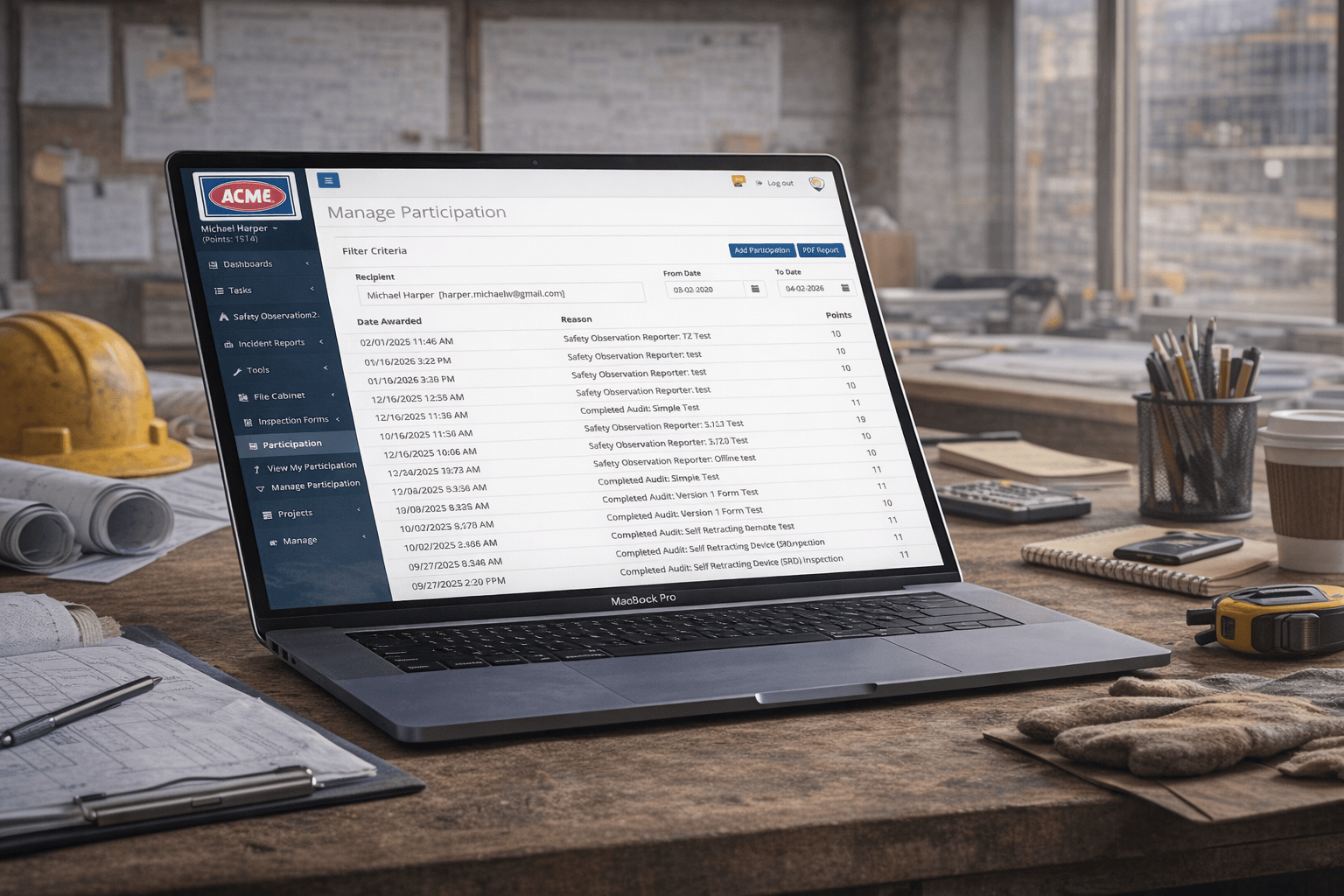
Turn participation data into something leaders and employees can actually use.
The value is not the point total by itself. The value comes from making involvement visible and giving the organization a consistent way to reinforce, recognize, and discuss participation.
Configure
Set point values for the supported activities your organization wants to emphasize instead of adopting a one-size-fits-all scoring model.
Recognize
Capture supported activity and use authorized manual adjustments to account for meaningful contributions that happen outside automatically tracked workflows.
Discuss
Review participation history during coaching, recognition, annual-review, and development conversations without treating points as a substitute for leadership judgment.
Add or deduct points when the participation record needs additional context.
Not every valuable contribution begins with an SSC record. Authorized administrators can manually add or deduct participation points and document the reason for the adjustment, giving organizations a way to recognize meaningful involvement while keeping the history centralized.
See the pattern created by many small contributions over time.
A single safety activity rarely tells the whole story. Participation history brings documented involvement together across a selected period, helping leaders see consistency, changes in participation, and contributions that might otherwise be forgotten.
Give leaders and employees a shared set of facts to discuss.
Participation history can support annual reviews, one-on-one meetings, coaching, recognition, and development discussions by providing a common record of involvement. It adds useful context without replacing the judgment and conversation that good leadership still requires.
Make proactive involvement visible before outcomes tell the story.
Traditional safety measures often concentrate on injuries, incidents, and other outcomes. Participation Tracking helps organizations also pay attention to the employee involvement that happens earlier, creating another way to understand how actively people are contributing to the safety program.
Use points to reinforce involvement, not to reduce safety performance to a score.
A high point total does not prove that an employee is safer or more effective, and not every activity in SSC automatically earns points. Participation Tracking is most useful when point values reflect organizational priorities, contributions are considered in context, and leaders use the history to support meaningful recognition and conversation.
Move beyond anecdotal impressions of who is involved.
When employee involvement is documented consistently, Safety Managers and leaders gain a clearer view of participation across the workforce. That visibility can help identify employees who contribute regularly, recognize positive involvement, and start constructive conversations where participation has been limited.